Comic Book Confidential is documentary by Ron Mann that examines the phenomenon of comic books in the United States since their inception in the 1930's up to the present (which at the time was the late 1980's).
The film does a nice job of explaining the history of the medium through an array of quality interviews with comic pioneers like William M. Gaines (founder of EC Comics and MAD Magazine), Jack Kirby (creator of Captain America) and Will Eisner (creator of The Spirit). The documentary also examines much of the controversy that surrounded comic books in their early days when many, including the US government, were of a mind that comic books could be the downfall of the nation's youth.
The film touches on the super hero genre (with interviews with Marvel's Stan Lee) but mainly focuses on the outsiders and underground comic evolution. There are many great interviews with R. Crumb (Zap!, Mr. Natural, Fritz the Cat), Art Spiegelman (RAW, Maus), Gilbert Shelton (The Fabulous Furry Freak Brothers) and Harvey Pekar (American Splendor). There is also an examination of the role of women in comic books with the likes of Lynda Barry (Ernie Pook'sComeek) and SharyFlenniken (Trots and Bonnie). The film also visits with some then relatively new faces to the art form like Jaime Hernandez (Love and Rockets), Frank Miller (The Watchmen) and Sue Coe (How to Commit Suicide in South Africa).
The interviews are fantastic and are juxtaposed together nicely with examples of the artist's work, often narrated by the artist themselves. Fans of comic books will definitely enjoy this trip through the diverse and wonderful world of comics.
Punk: Attitude is a documentary showcasing the history of punk rock music and culture in the United States and in the United Kingdom. The film uses archive footage of classic punk performances as well as current interviews with punk rock musicians, fans and promoters. The main complaint many people have with this film is the bands that were not mentioned (Stiff Little Fingers, The Replacements, etc) but honestly, there's no way that a film, no matter how in depth, could mention every band/artist that helped shaped the face of punk rock music.
The film does do a good job of giving the audience a sense of how punk rock happened and why. This film probably won't shine any new light on the genre for people who have been fans of punk rock music for a while, in fact many of the performance footage has been used in several other documentaries and specials.
The film spends most of its time focusing on and discussing the early punk bands of the late 1970's such as The Ramones, The Dead Boys, The Clash, The Sex Pistols and The Damned. The film then gives a brief rundown of the 1980's hardcore punk scene but doesn't delve at all into non-hardcore punk bands of the 1980's (The Minutemen, The Replacements, Husker Du). The film then shows some even briefer clips of some pop-punk bands of the 1990's and 2000's. Honestly, I'm glad the film chooses to focus most of it's attention on the early 70's punk movement because I feel that these were the best and most significant punk bands. Perhaps a sequel is in order for a more in depth look at more punk bands from the 80's and 90's.
Overall, the film is very well done. It should be very enjoyable for fans of punk rock music and a great history lesson for anyone who thinks punk rock started with Green Day.
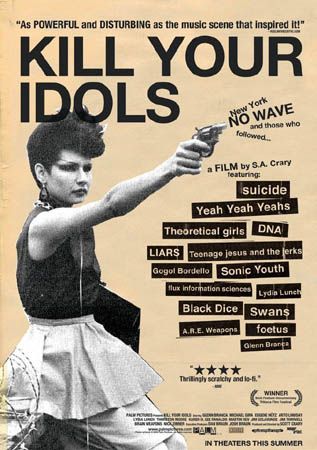
Kill Your Idols is a documentary film focusing on the No Wave music scene of New York City in the late 1970's and early 1980's and the influence it had on current noise rock bands like Sonic Youth, The Yeah Yeah Yeahs, The Liars and Black Dice. The film features interviews with many founding members of the No Wave scene such as Lydia Lunch of Teenage Jesus & The Jerks, Glenn Branca of Theoretical Girls and Arto Lindsay of DNA. The film also utilizes some rare footage of early No Wave performances by the fore mentioned bands and a few others.
For those not hip enough to know what the No Wave scene was all about, it was basically a DaDaist approach to music that sought to remove the trappings of traditional music and create "songs" that were totally original in structure and sound. The performers often thought of their performances more of as art than music. Most No Wave "songs" were atonal jumbles of sound with no distinct rhythm or melody. The documentary is in standard rock documentary fashion, juxtaposing interview segments between performance footage.
The first half of the film focuses on the early bands of the scene and how they came to be and what they were trying to invoke with their bands. There are some insightful and interesting sound bytes from some of the artists about the musical landscape of the time and trying to shatter the boundaries of conventional songwriting. However, a lot of the time the artists come off as a little too self-important. The film then jumps ahead 20 years to 2002 and checks in with some new bands that make weird noises. Some that are fairly well known (The Yeah Yeah Yeahs, The Liars) and some that are not (A.R.E. Weapons, flux information sciences). The newer bands, for the most part come off, as sub-mental retards not capable of completing an entire sentence without the word "like". Especially the Yeah Yeah Yeahs. By the time the movie was over I think I heard Karen O say "Like, ya knyow" about 100 times. The Black Dice came off as the most genuine and intelligent, which isn't saying a whole lot. Sonic Youth serves as the bridge between these two generations of noise makers and is probably the reason 80% of people will pick up this DVD. Thurston Moore and Lee Ranaldo offer some interesting anecdotes and thoughts on the No Wave scene and how it shaped Sonic Youth's sound. However, there's a huge shortage of performance footage from Sonic Youth. I was really hoping to see some early 1980's footage of a young Sonic Youth live in concert.
My biggest complaint about the film is probably the subject itself. I have listened to several No Wave albums and can appreciate their attempt to create something totally new and unconventional. There's just one problem; most No Wave music is utterly unlistenable. It's like, I dig your theory, guys, but not your product. See, what really got me angry was listening to these aging hipsters bitch and moan about how important what they were doing was and how commercial and boring the music today is. What a load of shit. I mean, sure you may have influenced a handful of marginally popular bands, but let's face it, most of the time these "artists" were just dicking around. And then to hear Lydia Lunch bitch about how boring music today is when I can think of nothing more boring than listening to Lydia Lunch play atonal sounds on a guitar and scream into a microphone.
The irony is that there was a real musical revolution happening right under their noses, where most musical revolutions happen; in the black community. Like No Wave it sought to shed the trappings of conventional guitar based blues music. It too also started in the underground, and not the fake fucking art underground either, the real underground of the streets. But unlike No Wave this musical revolution actually got people's attention, connected with the people, it was exciting and it has endured to today. Of course, I am talking about hip-hop. But that revolution doesn't fit into their lily white, New York artsy, pretentious idea of what musical rebellion is, so I guess it's just another "boring" "conventional" musical form to them. Fuck 'em.